Our Patron: St. Charles Borromeo
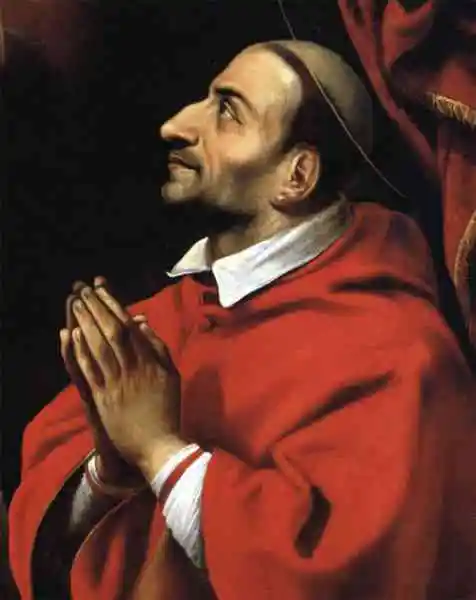
Fr. Adrien Bresy, in a profound act of humility, chose St. Charles Borromeo as the heavenly Patron and Protector of the Congregation. This choice was deeply symbolic, as the saint’s death centenary in 1684 perfectly coincided with the year of the Congregation’s foundation. Laying aside any desire for personal honor and echoing the selfless words of St. John the Baptist—“He must increase, I must decrease”—Fr. Adrien looked to the illustrious Cardinal of Milan as a spiritual North Star. He envisioned the Sisters following in the Saint’s footsteps, guided by a way of life that mirrored his own apostolic ideals. Indeed, the many virtues found in St. Charles were reflected in Fr. Adrien himself; as Jesus taught that “a tree is known by its fruits,” the enduring history and works of the Sisters continue to bear witness to this shared spirit of devotion.
The life of St. Charles Borromeo was one of noble origins transformed by divine service. Born on October 2, 1538, in the Duchy of Milan, he was the second son of Count Gilbert Borromeo and Margaret de Medici—whose younger brother, Angelo, would later become Pope Pius IV. Despite his high aristocratic standing, St. Charles dedicated his life to the Church, eventually becoming a pivotal figure in the Counter-Reformation and a tireless advocate for the poor. Canonized in 1610 by Pope Paul V, his legacy as a reformer and compassionate shepherd remains the cornerstone of the Congregation’s mission, providing a timeless model of holiness and structural discipline for the Sisters to emulate.
The Illustrious Legacy of St. Charles Borromeo
St. Charles Borromeo stands as one of the most influential figures of the Counter-Reformation, serving as a pillar of ecclesiastical reform and a patron saint for bishops, cardinals, and spiritual leaders. A man of immense intellectual caliber, he earned his doctorate in both civil and canon law from the University of Pavia in 1559. His rise was swift; the following year, his uncle, Pope Pius IV, appointed him Cardinal and Archbishop of Milan. In this capacity, he headed the Consulta, a high-ranking position that effectively made him the Secretary of State to the Pope. His leadership was most notably defined by his direction of the third convocation of the Council of Trent (1562–63), where he played a decisive role in shaping the future of the Catholic Church.
When the Council concluded, St. Charles became the driving force behind the execution of its decrees, ensuring that the Church’s renewed vision reached every parish. He was largely instrumental in the publication of the Roman Catechism in 1566, a monumental text that provided a unified foundation for Catholic teaching. Following the death of his uncle, Borromeo’s influence continued as he participated in the conclave that elected Pope Pius V. Throughout his life, he transformed his high-ranking offices into instruments of service, blending rigorous administrative discipline with a profound commitment to the spiritual and physical welfare of his people..
A Legacy of Sacrifice and Service
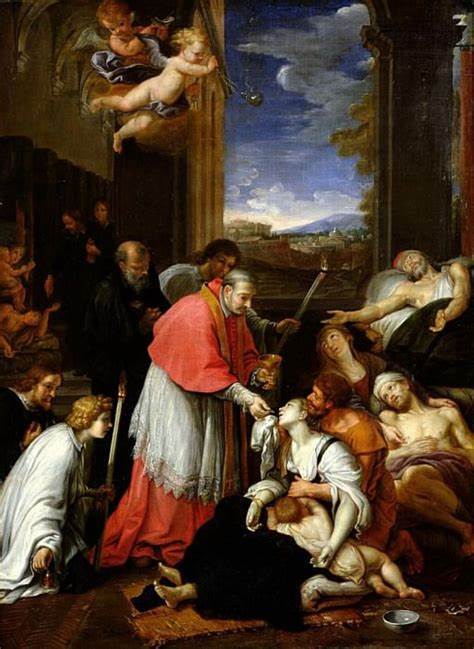
St. Charles Borromeo was a visionary architect of Catholic education, firmly believing that a well-formed clergy was the best defense for the faith. To this end, he established numerous seminaries and colleges in Milan and the Italian cities of Inverigo and Celano, creating a blueprint for clerical training that would endure for centuries. However, it was his profound personal courage during the Great Plague of 1576–78 that truly defined his sanctity. While others fled the contagion, St. Charles remained in Milan, heroically ministering to the dying and exhausting his personal fortune to feed the hungry and care for the sick. This selfless devotion won him the undying respect of his people and cemented his reputation as a true “Good Shepherd” who walked among his flock in their darkest hour.
The tireless pace of his mission eventually took its toll. In 1584, while on his annual spiritual retreat at Monte Varallo, St. Charles fell ill with “intermittent fever and ague.” His condition worsened rapidly upon his return to Milan, where he prepared for his final journey with the same devotion that had characterized his life. After receiving the Last Sacraments, he passed away quietly on November 4, at the young age of 46. Though his life was relatively short, the spiritual and structural foundations he laid—and the inspiration he provided to future founders like Fr. Adrien Bresy—ensure that his spirit lives on through the mission of the Sisters of St. Charles Borromeo.